

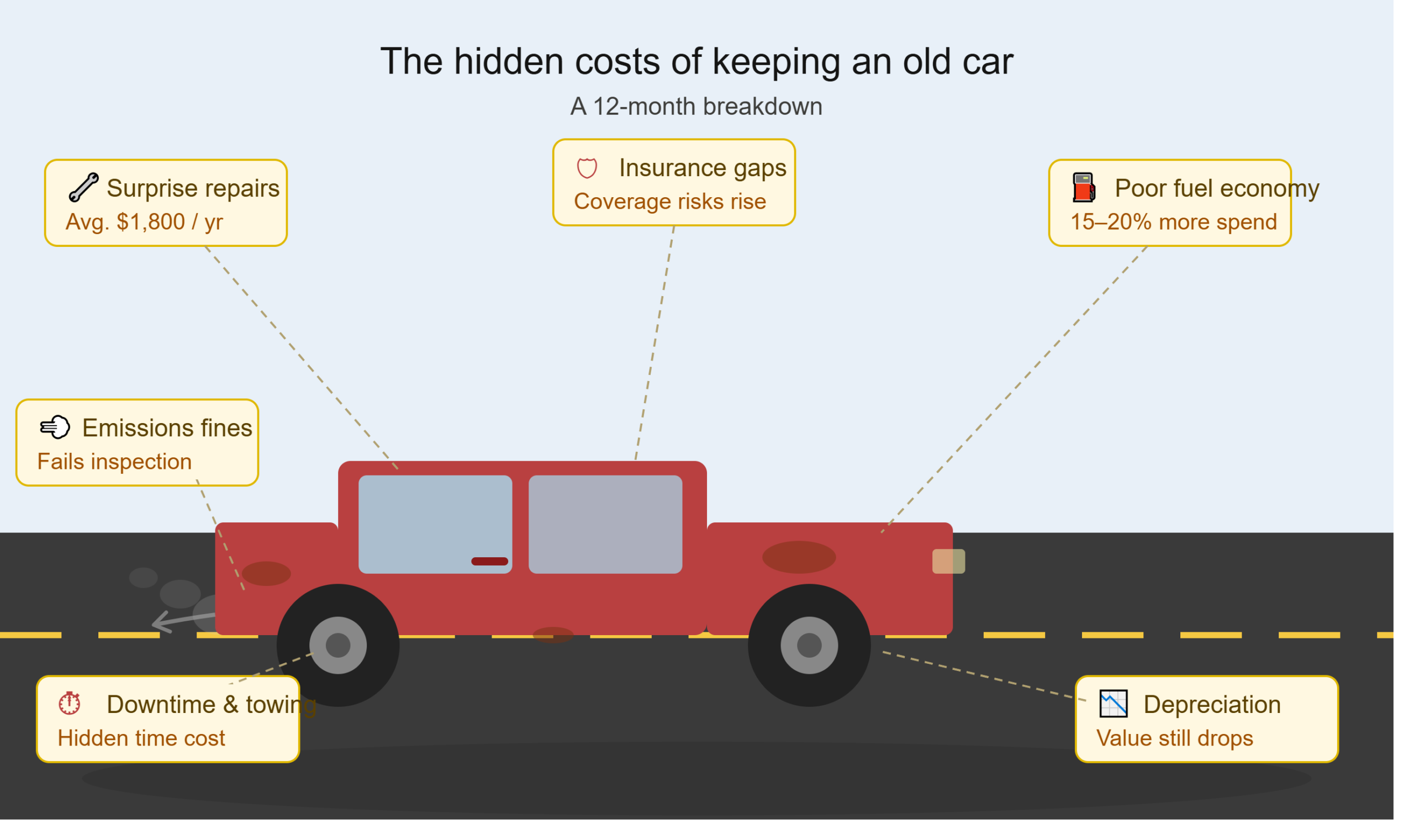
Costs of keeping an old car are easiest to assess with your own records, not a made-up annual average. A reliable older vehicle can be useful; a car with repeated failures can also consume repair money, transport time and storage space.
Use this Georgia owner’s checklist to compare the next twelve months. It is a planning framework, not a forecast of a specific repair bill or a promise that selling is always cheaper.
Separate past spending from the decision ahead
List recent work so you know the car’s history, but do not keep paying simply to justify money already spent. Ask a qualified repairer what is currently wrong, which repairs are necessary and which future costs are genuinely predictable.
Our repair-or-sell decision guide helps separate a useful repair from an assumption that every new expense must be recovered by keeping the car longer.
Months one to three: establish the baseline
Gather insurance bills, registration records, maintenance receipts, repair estimates and actual fuel use. Identify immediate safety or roadworthiness concerns and the cost of addressing them. Do not treat an unsafe car as usable merely because you plan to spend less.
Track transport alternatives during repairs: rides, rentals, public transport or use of another household vehicle. Include actual costs and practical availability rather than assuming a free replacement trip.
Months four to six: record reliability and interruptions
Note breakdowns, tow charges, repair visits and time without the vehicle. Record missed work or disrupted responsibilities where you can establish a real effect; do not invent an hourly loss for every inconvenience.
Distinguish routine maintenance from a pattern of unresolved faults. Ask for a diagnosis before authorizing repeated replacement parts that may not address the cause.
Months seven to nine: review fixed costs and storage
Look at insurance, registration and any parking or storage payments. If the car is no longer used, check the appropriate registration and insurance steps rather than simply stopping payments or assuming an off-road vehicle creates no obligations.
Georgia DOR’s registration cancellation guidance explains the process and advises cancelling registration before insurance. Coordinate changes with the county tag office and insurer for your circumstances.
Months ten to twelve: compare the actual alternatives
Estimate the coming year using known necessary repairs, normal maintenance and the transport you need. Compare that with a realistic replacement plan, including acquisition, finance if applicable, insurance and operating costs.
Do not compare an old car’s repair bill with an imaginary replacement that has no purchase or ownership costs. Likewise, do not assume a large recent repair guarantees another year without problems.
Use a simple decision record
- Known necessary work and written estimates.
- Recurring ownership and transport costs.
- Actual downtime and practical impact.
- As-is vehicle offer and any collection costs.
- Replacement options and their complete costs.
Our junk-car payout factors guide explains how to request a useful as-is offer. That figure is one input to the decision, not a guarantee that the entire replacement cost will be covered.
If you decide to sell
Have the appropriate ownership documents ready and disclose the actual condition. For an Atlanta-area vehicle, our Atlanta junk-car removal team can discuss the offer and collection needs. Keep the sale records and complete the applicable registration and insurance steps.
Frequently asked questions
Is an old car always more expensive than replacing it?
No. Compare your car’s condition and costs with a realistic replacement, not a blanket age rule.
Should I count money already spent on repairs?
Keep it in the history, but base the next decision on expected future usefulness and costs rather than trying to recover sunk spending.
Does a junk-car offer tell me whether to replace the car?
No. Compare the offer with repair information, transportation needs and the complete alternative costs.




2 Responses